Here is the article that was published in the Clay Today on July 3, 2014. Click here to read the article on the Clay Today Web Site.
Click here to download the PDF format of the actual newspaper article as shown below.
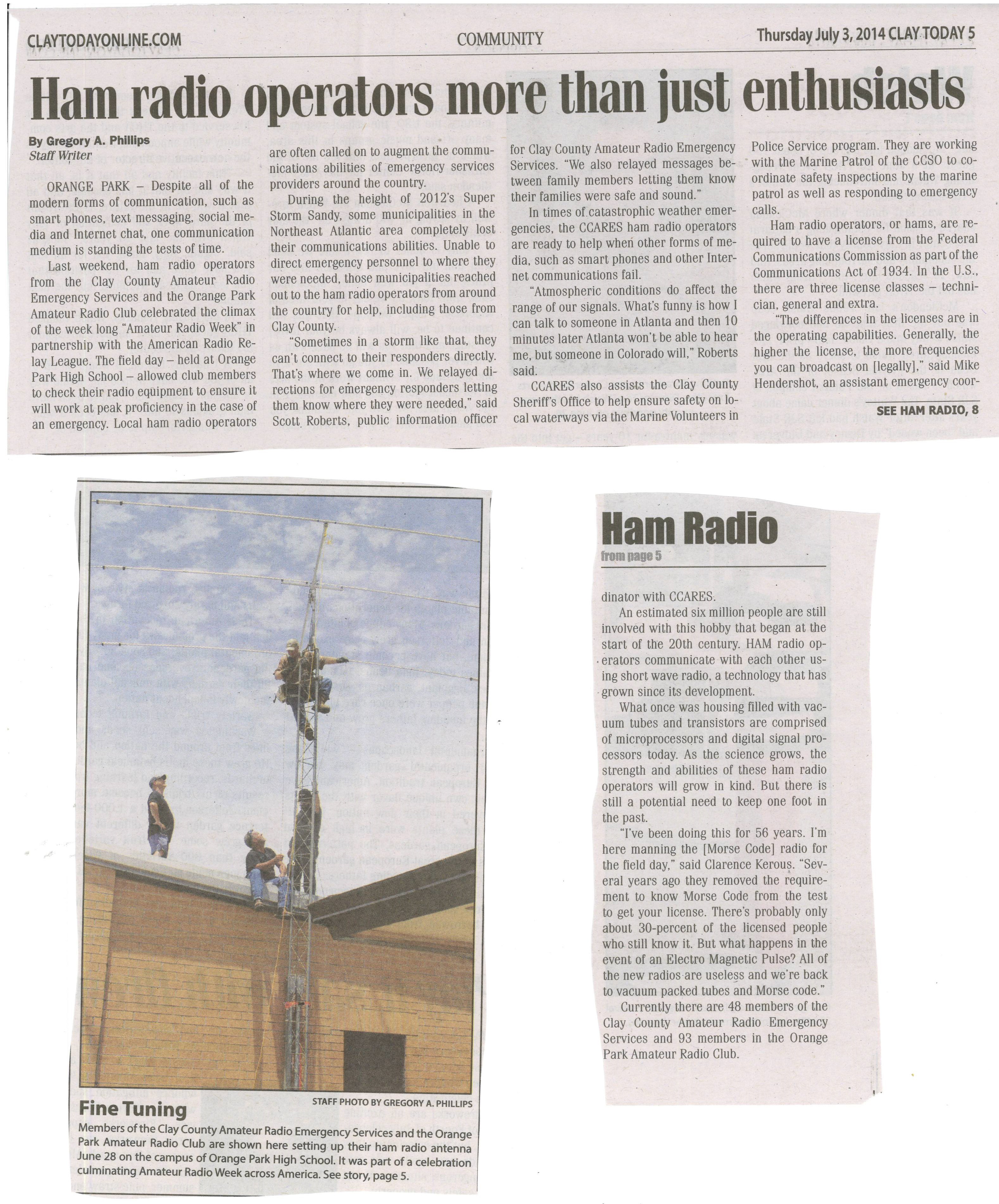

Here is the article that was published in the Clay Today on July 3, 2014. Click here to read the article on the Clay Today Web Site.
Click here to download the PDF format of the actual newspaper article as shown below.
In an effort to make sure that people KNOW who the ARES Amateur Radio Operators are in an event or emergency, we have come up with these requirements and guidelines for apparel. Click here to real the whole article on the Crown District ARES Site
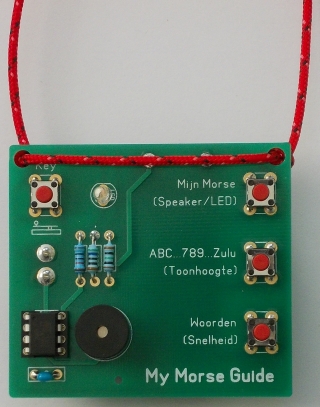
My Morse Guide is an electronics kit aimed at young people.
The kit delivers both some fun in soldering the kit together as well as having a kit for playing with Morse code
Submitted by Mark Field, N4QLC
When the power went down for more than 145,000 Pacific Gas and Electric (PG&E) customers in San Luis Obispo County, California, on June 23, members of the Cal Poly Amateur Radio Club (W6BHZ) sprang into action to provide needed emergency communication. The response by student and alumni members consisted of collecting status information from remote stations and relaying information obtained by net control through official channels, the club said in a news release.
“CPARC demonstrated the importance of Amateur Radio Emergency Communications support in a professional and timely manner, providing the most current firsthand reports to the community,” the club said.
The situation was exacerbated by the absence of coverage on broadcast news outlets, in some cases due to the outage, and by a call overload on the PG&E information number. “Fortunately some residents have radio scanners and were listening to the radio net managed by CPARC on 146.67 MHz,” where the countywide SLOECC net had opened, CPARC said. Some of these listeners credited the net with providing timely and independent reports.
The outage, attributed to a power substation problem, lasted about 2 hours.
06/19/2013
Taken from ARRL.ORG
A new version of Trusted QSL (TQSL) software for Logbook of The World (LoTW) is available to users. TQSL v. 1.14.1 may be downloaded from the LoTW page. The new software lets users upload log files to LoTW directly from Trusted QSL, saving steps. TQSL v 1.14.1 also will automatically check for updates, prompting users to download and install. Among other new features, any QSOs that have been successfully uploaded to LoTW or saved to a file are registered in a database, and exact duplicates are automatically stripped from future logs (this feature may be disabled). TQSL also will ensure that the CQ and ITU zones and any subdivisions (US state/county, Canadian province, Russian oblast) are valid with respect to each other. This should reduce the incidence of swapped CQ/ITU zones and generally help to ensure more accurate location data is uploaded. Full information on the advantages of upgrading are available on the LoTW website.