
Category Archives: General
Partners in Service: FEMA Announces Plans for September National Preparedness Month
Next month is National Preparedness Month with the theme Prepared, Not Scared. Be Ready for Disasters. National Preparedness Month (NPM) is recognized each September to promote family and community disaster and emergency planning now and throughout the year. This year’s campaign will feature PSAs and multimedia products around four weekly themes:
· Week 1: Sept 1-7 Save Early for Disaster Costs
· Week 2: Sept 8-14 Make a Plan to Prepare for Disasters
· Week 3: Sept 15-21 Teach Youth to Prepare for Disasters
· Week 4: Sept 22-30 Get Involved in Your Community’s Preparedness
Content has been loaded on the Ready.gov National Preparedness Month Toolkit webpage. This year, FEMA wants participants, which include ARES operators, to share their activities and success stories. The longtime ARRL partner wants brief descriptions of what you are planning for National Preparedness Month. Send them to FEMA-IGA@fema.dhs.gov with the word NPM in the subject line. An appropriate, brief submission would be your planned or conducted ARRL Simulated Emergency Test (SET) activity. Many groups will be holding their SET during September and through the fall. The primary League-sponsored national emergency exercise is designed to assess the skills and preparedness of ARES and other organizations involved with emergency/disaster response. Here’s an opportunity to let FEMA know about it.
In June 2003, ARRL became an official affiliate program of Citizen Corps, an initiative within the Department of Homeland Security to enhance public preparedness and safety. The Statement of Affiliation makes ARRL an affiliate under the four charter Citizen Corps programs–Neighborhood Watch, Volunteers in Police Service, Community Emergency Response Teams and Medical Reserve Corps.
FEMA and FCC Conduct Nationwide Emergency Alert System Test
Release date: July 24, 2019Release Number: HQ-19-077
WASHINGTON – FEMA, in coordination with the Federal Communications Commission, will conduct a nationwide test of the Emergency Alert System (EAS) on Wednesday, Aug. 7, 2019.
Continue readingFirst Annual Northern Florida Section Hurricane Exercise
Beginning 0800 on Saturday, 3 August 2019, all Florida county Emergency Operating Centers (EOC’s) will take part in an exercise.
The exercise will involve communicating between each county to the State EOC in Tallahassee. Only personnel operating from their respective county EOC’s may participate.
Digital messages will be sent to the state EOC by voice and digital modes. HF SSB messages will be sent as follows:
80 Meters: 3.950 MHz @0900 on the morning NFL ARES net.
60 meters: 5.3715 MHz 0800-0830
40 meters: 7.242 MHz 0830-0900
A special message will be sent requesting a 50-amp power supply on 3.955 MHz sometime between 0800-1000.
SARNet check-ins will be taken starting 0900.
Special voice and digital tests will take place at 1400 and 1700 hours on 3.950 MHz. Digital stations will use WinLink/Winmor.
All ARES members are encouraged to listen in on the nets and provide signal strength reports to K4AWG by e-mail or at the next ARES meeting on 6 August 2019.
How to Clean Up after a Battery Leak
| Many hams have had the unfortunate experience of old batteries leaking in a piece of gear or a flashlight, creating a mess. Business technology news site ZDNet recently offered its procedure (Click here for full article) for cleaning it up. The brief online presentation recommends taking some precautions about coming in contact with the white discharge — specifically potassium hydroxide in the case of alkaline cells, a caustic irritant. An old toothbrush or something similar can start the project, along with a small scraper, and cotton swabs dipped in water. Start by removing and properly disposing of the bad cells and then brushing out the worst of the material — preferably outdoors or over a container to catch the remnants. |
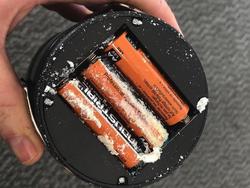
The article advises against using any sort of acid such as vinegar or lemon juice, lest it cause corrosion problems of its own. It suggests a fiberglass scratch brush for scrubbing the battery compartment contacts clean, although other tools may work as well. Deoxit D5 or similar contact cleaner also comes in handy, with a tiny dab of dielectric grease or silicone paste as a finishing touch to inhibit future corrosion if a leak occurs. Other tips to head off problems down the road include using only name-brand batteries, avoiding mixing old and new batteries, removing batteries from devices not in use, avoiding exposing batteries to extreme heat or cold, and minding battery expiration dates.